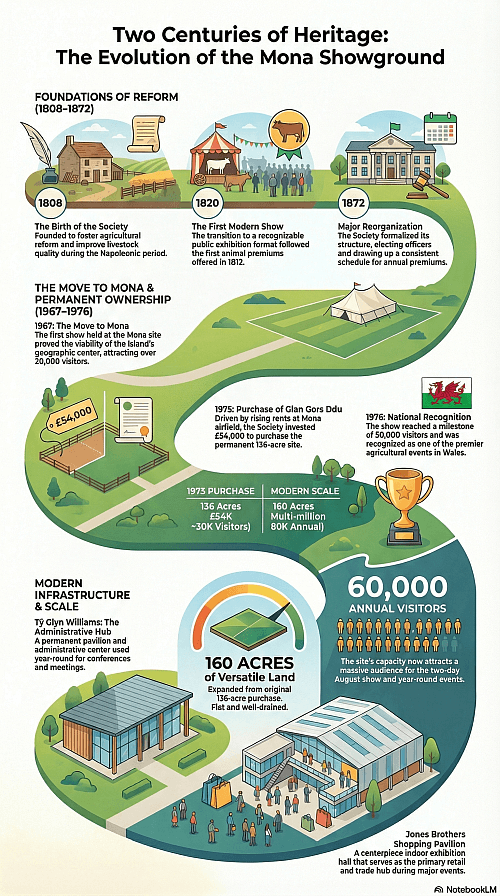
The history of the Mona Showground is deeply intertwined with the Anglesey Agricultural Society, which was founded in 1808 during a period of agricultural enlightenment to promote farming reforms. While the Society began its work early in the 19th century, the transition to public exhibitions was gradual; the first premiums for animals were offered in 1812, and the inaugural agricultural show in a format recognizable today did not occur until 1820.
The Society underwent a major reorganization in 1872, electing new officers and formalizing the annual show structure. Throughout the late Victorian era, the event expanded to include a wider range of activities, but it faced significant interruptions during the World Wars. The show was adjourned during World War I, relaunching in 1920, though it struggled to regain its previous standards until the mid-1930s. Following World War II, the event adapted to a more mobile society and the rising tourism industry, reaching 14,000 visitors by 1955.
A pivotal moment in the showground’s history occurred in the 1960s under the leadership of J. Glyn Williams, who modernized competitive classes and introduced diverse exhibitions like hairdressing to broaden the event’s appeal. In 1967, the show moved to the Mona Airfield for the first time, exceeding expectations with over 20,000 visitors and proving the viability of the island’s geographic center as a hub.
By 1970, the show had transitioned into a two-day event to accommodate growing interest from tourists without neglecting the needs of the farming industry.
In 1975, facing steep rent increases for the Mona airfield, the Society took the strategic step of purchasing its own land. They invested £54,000 to buy Glan Gors Ddu, a 136-acre farm near Gwalchmai, which provided the foundation for the permanent infrastructure seen today. By 1976, the event was recognized as one of the premier shows in Wales, with attendance surging to 50,000 people.
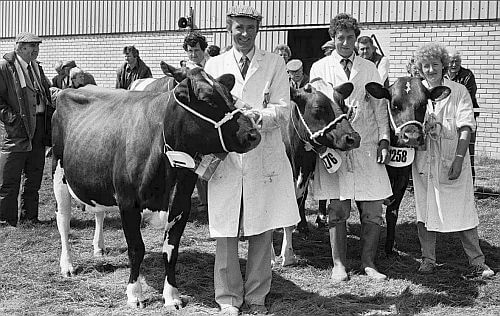
Today, the showground is described as a 160-acre facility that serves as a multi-functional hub for North Wales. Its development has included the construction of several permanent buildings:
- Tŷ Glyn Williams: The primary administrative and pavilion hub used for conferences and meetings.
- Jones Brothers Shopping and Exhibition Hall: A major indoor retail center.
- Cadarn Building: A specialized cattle shed reflecting the site’s agricultural roots.
- “Y Cowt”: A recently revamped entertainment zone for live music and family activities.
The showground faced a severe financial crisis due to the COVID-19 pandemic, which forced the cancellation of the 2020 show and other organized events. This led to the dismissal of professional staff, leaving the Society dependent on a dedicated base of volunteers to secure its future.
During this same period, a political controversy arose when the Society sought to sub-lease land at the Mona Industrial Estate for HGV storage to provide a financial lifeline during the pandemic; however, the Isle of Anglesey County Council refused the application, citing traffic and MOD restrictions.
Despite these setbacks, the showground remains a critical economic engine, hosting major events like the Anglesey County Show, which now attracts approximately 60,000 visitors annually.
https://www.angleseyshow.org.uk/the-society/history