
Circulating schools were a major educational movement in 18th-century Wales and were active in areas such as Anglesey. They were founded by the Welsh clergyman Griffith Jones in 1731 to improve literacy among the rural population. Each school was temporary and moved from parish to parish, especially in rural areas where permanent schools did not exist. Each school usually stayed in one community for about three months, then the teacher moved on to another location.
The main aim was religious education and literacy. Jones believed people needed to read the Bible in their own language in order to understand Christianity. As a result:
- Teaching was conducted in Welsh, the language of the population.
- The main texts used were the Welsh Bible and the Church catechism.
- The schools focused almost entirely on teaching people to read rather than writing or other subjects.
By 1761 Anglesey had 30 circulating schools with about 1,190 scholars.
Over 1746–1777 around 435 school sessions were held on the island, reaching more than 20,000 scholars.
They were later replaced by Sunday schools, which continued the emphasis on literacy and religious instruction.
The history of schooling in Gwalchmai in the 19th century is characterized by a “dual-school system” born out of religious rivalries which existed through the UK.
Religion was the most significant factor.
Anglican Dominance: The National Society (founded 1811) aimed to establish a school in every parish to provide instruction according to the teachings of the Church of England. These schools often required pupils to learn the Anglican Catechism and attend church, hoping to draw them away from Nonconformist chapels.
Nonconformist Resistance: In response, the British and Foreign School Society (founded 1808) established schools that provided non-denominational Christian instruction. Local chapel cultures,, supported these schools as a direct alternative to Anglican influence.
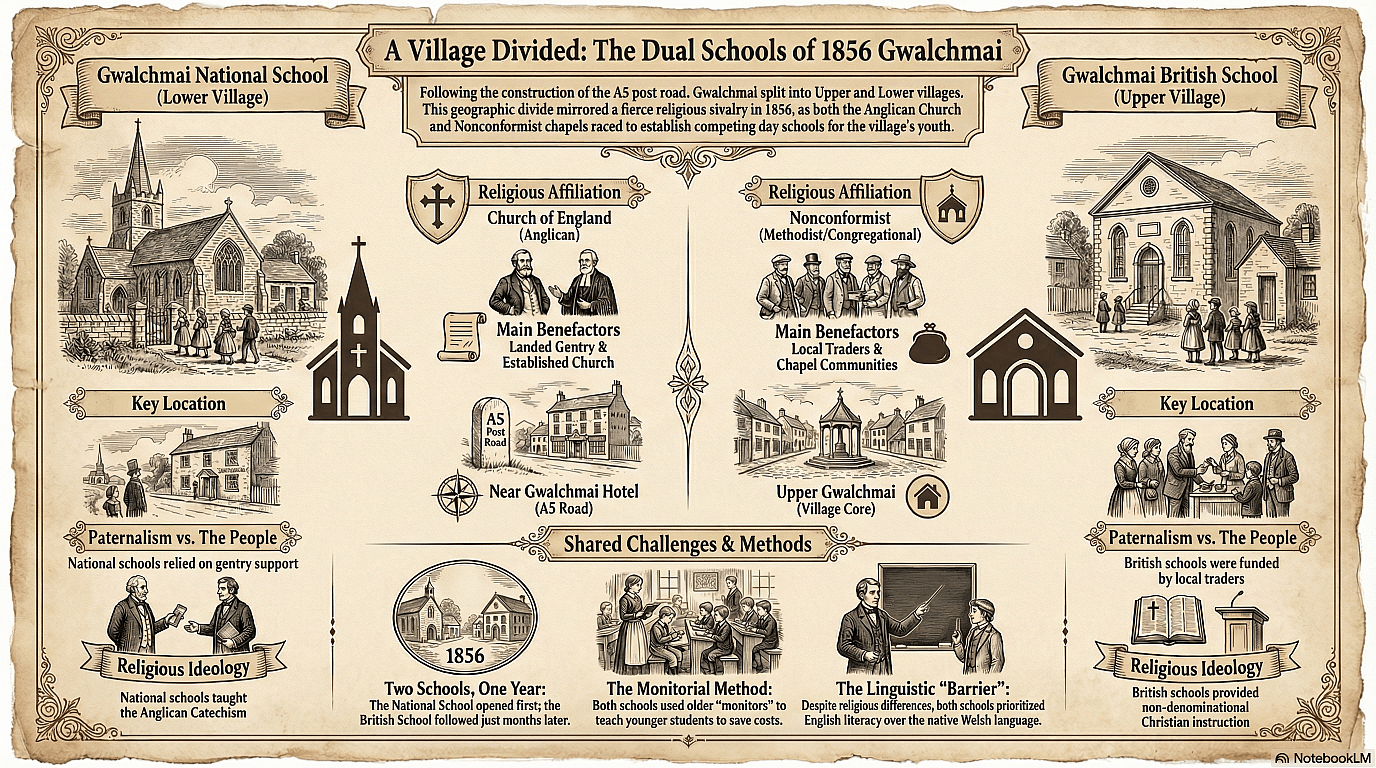
Establishment vs. Local Traders: National schools generally received heavy support from the landowning gentry and the established church. Conversely, British schools were more frequently supported by local traders and the Nonconformist middle class.
Starting in 1833, both societies began receiving government grants, leading to a race for expansion.
There are some early records of children were taught to read at a Gwalchmai Methodist meeting house in 1801. For most children this was the only education available at that time. There were 26 Calvinistic ( mainly) Sunday schools on Anglesey by 1811. It is recorded that almost a hundred children gathered in a chapel in Gwalchmai during the summer months to be taught to read Welsh.
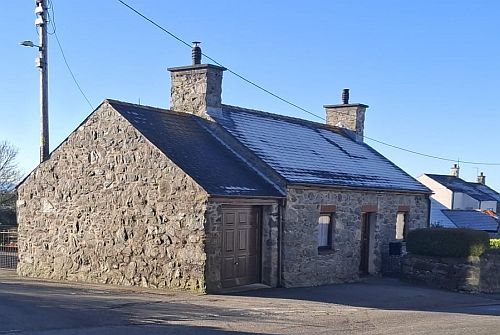
There is a record that in 1836 the Anglican church was holding weekly meetings, possible in Hen Ysgoldy Gwalchmai Uchaf.
A Rev John Philips addressed a series of meeting at Gwalchmai and Amlwch in 1856 with a view to establishing a British School as each location.
The formal history of day schools in Gwalchmai began in 1856 with a direct competition between the Anglican establishment and Nonconformist residents.
- Gwalchmai National School (1856): Managed by the Church of England, this school initially served approximately 43 children. Its founding followed the 1845 restoration of St Morhaiarn Church, as the Anglican incumbent sought to reassert ecclesiastical influence through education.

- Gwalchmai British School (1856): Opened in Gwalchmai Uchaf, just months after the National School, this was a Nonconformist response intended to provide an alternative to the Anglican Catechism. It was heavily supported by local chapel culture, specifically Jerusalem Chapel (Calvinistic Methodist) and Moriah Chapel (Congregationalist).
This local rivalry mirrored a broader national struggle where Anglican National schools aimed to draw children away from chapels, while Nonconformists fought for non-denominational instruction. This tension created a surprisingly dense but sectarian educational network in the village.
While these rivalries were fierce, they also ensured that Gwalchmai achieved near-universal literacy during the 19th century, as both sides viewed the provision of schooling as a spiritual and social necessity.
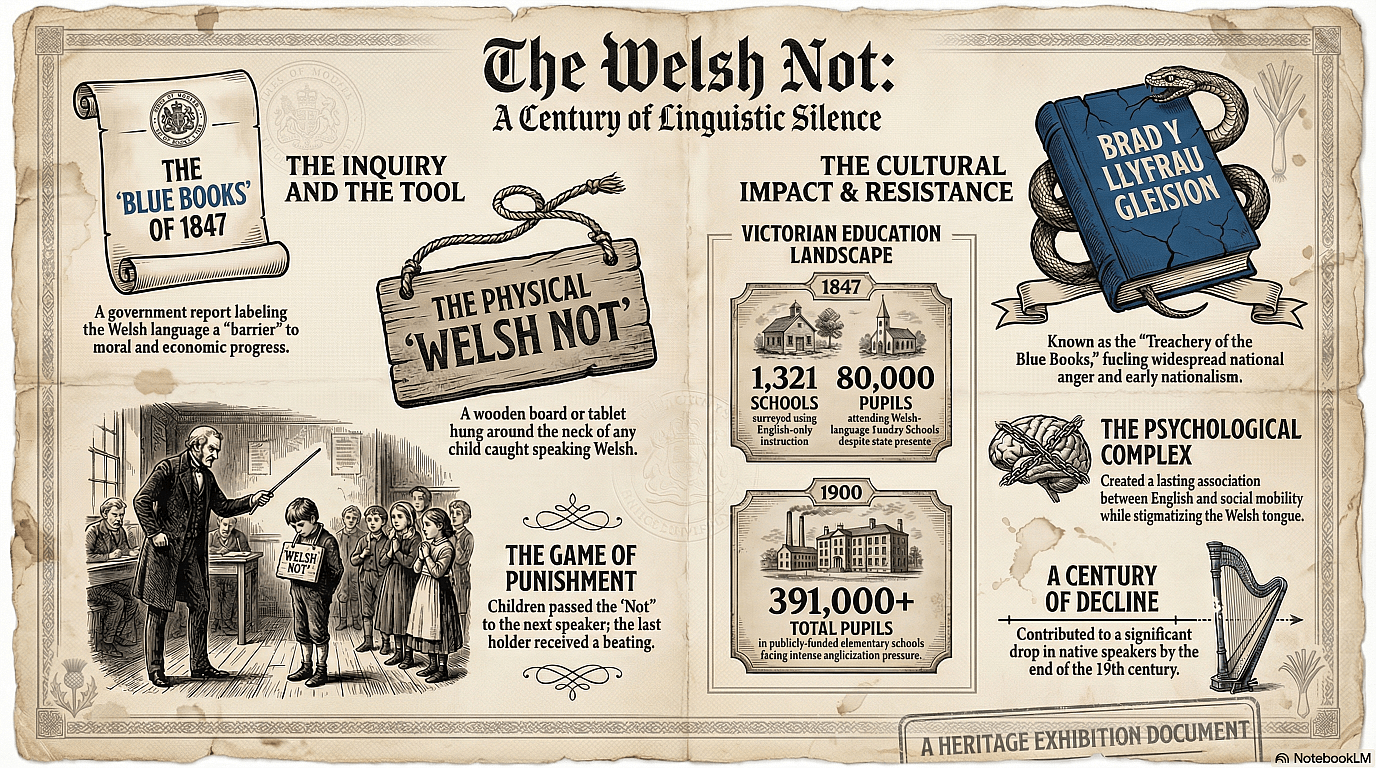
The atmosphere in Gwalchmai’s early schools was shaped by national pressures, specifically the 1847 Blue Books report, which infamously criticized Welsh education as “primitive” and “barbarous”. Following the report, an ideological shift occurred where many parents believed social mobility required English proficiency. This led to the adoption of the “Welsh Not”—a wooden board hung around the necks of children caught speaking Welsh—a practice recorded in school logbooks across Anglesey.
In September 1863, Robert Jones the headmaster at a National School in Llangefni promised that ” all those who endeavored to speak English could amuse themselves by trying to bite and apple on a string, while Welsh speakers played in the yard”. When this failed to stop Welsh being spoken he decided to cane Welsh speakers. In April 1865 he kept behind a class of girls for ” willfully talking Welsh during recreation”. It was noted that school children in Gwlachmai were often “taught English through the medium of English” Which often meant that they could read the language but not understand its meaning.
Before the 1862 Revised Code or for schools that did not yet receive state aid, both British and National schools relied on the same primary methods of financial support.
School Pence: Parents were required to pay a small weekly fee (typically 1d or 2d) for each child.
Voluntary Subscriptions and Donations: National schools often received support from the Anglican gentry and the Church, while British schools were more frequently supported by local traders and Nonconformist chapel communities.
Endowments: Some schools were successor institutions to older charitable legacies or endowments. In 1863 Robert and Richard Davies of Menai Bridge funded the British school at Gwalchmai.
Both systems also shared the monitorial system before the state took greater control. This method used older, more capable pupils to pass information to younger children, allowing a single master to oversee very large classes at a minimal cost.
Logbooks from Gwalchmai National School (1863–1880) reveal that education was frequently interrupted by the agricultural calendar. Schools often closed for harvests, local hiring fairs, or outbreaks of disease. Additionally, under the “Payment by Results” system (1862), school funding depended on pupils’ performance in annual exams, leading to a mechanical and stressful style of rote-learning.
The “Payment by Results” system was a school funding method introduced by the British government to both British and National schools through the Revised Code of 1862. Under this system, the amount of state grant money a school received was directly linked to two primary factors: pupil attendance and performance in an annual examination.
The system had several defining characteristics and impacts on the Victorian classroom:
- Focus on the “Three Rs”: The annual examinations primarily tested children on their knowledge of reading, writing, and arithmetic. While schools could eventually earn additional funding for subjects like geography or history, these were secondary to the core subjects.
- Mechanical Rote Learning: Because a school’s financial survival depended on high pass rates, teachers felt immense pressure to concentrate strictly on what the exams required. This led to a “mechanical” style of instruction characterized by rote learning and repetition.
- Superficial Attainment: Inspectors noted that children often learned to pass the tests without truly understanding the material. For instance, in reading exams, pupils might memorize entire books by heart, sounding fluent even if they could not actually read the words on the page.
- Pressure on Teachers: A teacher’s own salary was frequently linked to the outcomes of these examinations. This created a stressful environment where teachers feared for their livelihoods and were sometimes tempted to compromise the “honesty” of the examination process.The Gwalchmai British school Master was offered a salary of £20 in 1866.
- Impact on the Welsh Language: Since Welsh was not a grant-earning subject under the 1862 Code, the system further discouraged its use in schools, reinforcing the priority of English as the language of “opportunity” and state-funded progress.
The “Payment by Results” system was eventually dismantled as education moved toward a broader curriculum and more cooperative inspection methods. It was ended for the “three Rs” in 1890 and for all other subjects by 1897.
The 1870 Elementary Education Act changed the governance of schooling in Wales by authorizing the creation of local school boards, though its immediate impact on Gwalchmai was to supplement rather than replace the existing religious “dual-school system.
The Act allowed for the creation of school boards, which were elected bodies of local officials rather than religious managers. While Gwalchmai’s schools—the National School and the British School—were originally under direct Anglican and Nonconformist control, the Act provided a mechanism for communities to take charge of education through these democratic bodies. However, records indicate that in Gwalchmai, direct religious control by the parish and chapels remained the standard through the late 19th century.
The new school boards were granted local tax-raising powers and central funding to embark on a significant period of school building. These boards were established specifically in areas where “insufficient places” existed in voluntary religious schools. While Gwalchmai already had two established schools by 1856, the 1870 Act laid the groundwork for the dismantling of the voluntary system in favor of state-run education across Anglesey.
Under the 1870 Act and subsequent legislation in 1876 and 1880, school boards were empowered to make attendance compulsory for children aged five to ten. This was a major shift for rural villages like Gwalchmai, where attendance was often interrupted by the agricultural calendar. Furthermore, while parents originally had to pay “school pence,” the expansion of state-funded education eventually led to free elementary education in 1891, significantly improving participation rates.

The picture above was taken around 1895. The tall girl in the middle of the second row from the front is Nell Lewis who is also shown on the picture of the water mill. Second from the left in the first row is Margiad Elin Jones (Pen Bonc)
The era of local school boards was relatively short-lived. The 1902 Education Act abolished these boards and transferred the management of schools to County Councils
The Butler Act (1944): This legislation established the modern split between primary and secondary education. Gwalchmai children attended primary school until age eleven, after which they were typically sent to larger centralized secondary schools.
By the late 20th century, the education system moved to reverse the damage of the “Welsh Not” era. Following national reports in 1953, the system transitioned toward bilingualism, and Welsh eventually became a universal school subject.
The village maintains early years provision through Cylch Meithrin Gwalchmai, a registered charity that ensures children have a smooth transition into Welsh-medium primary instruction at Ysgol y Ffridd
Today, Ysgol y Ffridd provides a Welsh-medium primary education for up to 96 children. In 2021, pupils at Ysgol y Ffridd participated in “Utopias Bach” workshops, where they imagined a future Gwalchmai featuring flexible outdoor learning, the teaching of Welsh skills to newcomers, and even helpful robots.

Mwy am hanes ysgolion Gwalchmai gan Sharon Jones