
The UK census is a nationwide survey carried out every ten years to collect detailed information about the population. It asks households about age, gender, employment, education, ethnicity, and housing. The data helps the government and local authorities plan public services, allocate funding, and understand social changes, ensuring resources like healthcare, schools, and transport meet people’s needs effectively.
The following statistical overview of Gwalchmai (Trewalchmai) is based on data from some of the recent Census.
Population and Demographics
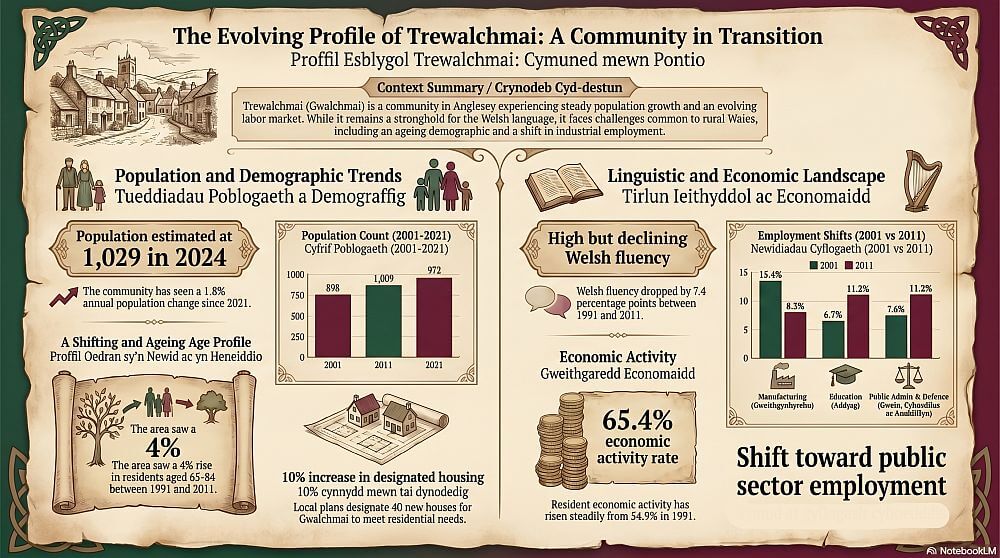
- Total Population (2021 Census): 972 residents, a slight decrease from 1,009 in 2011.
- Population Density: Consistent at 0.8 persons per hectare, which is lower than many other rural areas in Wales.
- Religious Belief (2021 Census): The community includes 486 Christians, 398 with no religion, and small numbers of Sikhs (5), Muslims (4), and Buddhists (1).
- Ageing Trends: There was a 4 percentage point rise in residents aged 65–84 between 1991 and 2011, alongside a decline in those under 24.
- 2011 Ward Age Structure: The largest age bracket was 45–64 (30%), followed by 25–44 (25%) and 0–15 (19%).
- Welsh Language: In 2011, 67.8% of the ward was fluent in Welsh. While a stronghold, this represented a decline of 7.4 percentage points since 1991.
- Long-term Trends: Although the absolute number of Welsh speakers increased by 55 between 2001 and 2011, the overall percentage fell because the general population grew at a faster rate.
- Economic Activity: The rate of economically active residents rose from 54.9% in 1991 to 65.4% in 2011.
- Employment Sector Shifts (2001–2011):
- Manufacturing: Declined from 13.4% to 8.3%.
- Education: Increased from 6.7% to 11.2%.
- Public Administration & Defence: Increased from 7.6% to 11.2%.
- Occupational Profile: Gwalchmai has a lower percentage of managers, directors, and professional occupations compared to the Welsh rural average, but higher percentages in technical and administrative roles.
- Benefits: Approximately 11% of the working-age population was on employment-related benefits in 2019, slightly above the Welsh average of 10%.
- Self-Reported Health: The number of residents reporting “good” health increased by 14 percentage points between 2001 and 2011.
- Limiting Illness: The rate of long-term limiting illness was 22.3 per 100 persons in 2019, slightly lower than the national average.
- Birth Health: Only 3.6% of single births were low weight in 2019, compared to the Welsh average of 5.5%.
- Cancer Incidence: Gwalchmai has lower-than-average cancer rates, which saw a steady decline between 2014 and 2019.
- Tenure: Home ownership rose from 63% in 1991 to 69% in 2011.
- House Prices: The average price for a detached house rose significantly from £52,655 in 1995 to £224,041 by 2019.
- The local development plan designated 40 new houses for Gwalchmai to meet community needs.
- Travel Times (2019 Public Transport):
- GP Surgery: 36 minutes (up from 15 minutes in 2014).
- Pharmacy: 56 minutes.
- Public Library: 66 minutes.
- Violent Crime: Recorded incidents rose from 0.71 to 1.66 per 100 persons between 2014 and 2019.
- General Performance: Despite the rise in violent crime, Gwalchmai generally performs better than or equal to the Welsh average for all other police-recorded incident indicators, including burglary and criminal damage.
Welsh Language
Industry shifts have significantly influenced the vitality of the Welsh language by altering the socioeconomic foundations of Welsh-speaking heartlands, driving migration patterns, and affecting the frequency of daily language use.
Certain industries serve as critical anchors for the language. Protection of these sectors is considered vital for maintaining Welsh in both the workplace and wider society.
- Agriculture: This industry is described as the “backbone of the Welsh language” in many rural communities. Nationally, the “Agriculture, Forestry and Fishing” sector has the highest proportion of Welsh speakers at 43.1%, with even higher concentrations in northern and western strongholds. For instance, in Anglesey, 73% of those in agriculture are Welsh speakers.
- The Public Sector: This is a major employer in Welsh-speaking regions, accounting for 30%–37% of the workforce in counties like Anglesey and Gwynedd. Shifts in this sector, particularly shrinkage due to austerity, disproportionately affect the language because Welsh speakers are more concentrated in public administration, health, and education than in the private sector.
Historical data from communities like Gwalchmai illustrates a broader shift in the employment landscape:
- Declining Manufacturing: Traditional manual sectors have seen a decline; for example, manufacturing employment in Gwalchmai dropped from 13.4% to 8.3% between 2001 and 2011.
- Growth in Service and Professional Roles: There has been a corresponding increase in public administration, defence, and education. Occupational data shows a rise in professional and administrative roles alongside a decline in “process plant and machine operatives”.
- The Visitor Economy: While tourism creates jobs, it is often characterized by seasonal, low-wage employment and a lack of security. Furthermore, profits from large tourism centers are frequently extracted by companies based outside the area, which can be detrimental to community sustainability.
Industry shifts have contributed to a persistent “cultural division of labour” in the strongest Welsh-speaking counties.
- Underrepresentation in Leadership: In Gwynedd and Anglesey, Welsh speakers are underrepresented in the most privileged socioeconomic categories, such as higher managerial and professional occupations.
- Linguistic Disparity in Management: The percentage of managers and senior officials who speak Welsh is often more than 10 percentage points lower than the percentage of Welsh speakers in the general workforce.
The restructuring of the economy has led to structural challenges that threaten the language’s future:
- Out-migration of Youth: A lack of high-skill economic opportunities leads to the continuous out-migration of young people from Welsh-speaking areas. This depopulation weakens the resilience of the language, as young people are the primary group responsible for intergenerational language transmission.
- Structural Economic Disadvantage: Welsh speakers as a social group often suffer from structural disadvantage because their communities are located on the periphery of the British economy, far from major prosperous centers.
- Impact of Major Developments: Large-scale projects, such as the proposed Wylfa nuclear power station, have the potential to transform the social fabric of communities. While they offer employment, they also risk encouraging further language shift if the workforce is primarily drawn from non-Welsh-speaking areas.